

Why Relocation Timelines Often Leave Belongings Without a Home
Moves rarely line up neatly. Your old lease ends on the 30th, but the new home isn’t ready until the 15th of next month. Or the buyer’s closing date moves up while the new house still needs repairs. These gaps are common, and they leave many families and businesses with furniture, equipment, or inventory that has nowhere to go.
Here are a few situations we see often:
- Closing date mismatches: Sellers must vacate before the buyer’s move-in date, or the reverse.
- Job start dates: A new role begins before housing is available, especially for military and corporate relocations.
- Renovation delays: Contractors run behind, and the new space isn’t ready for furniture.
- Temporary housing: A short-term rental or family member’s home can’t fit everything you own.
When this happens, a storage plan becomes part of the move rather than an afterthought. Planning for the gap early keeps your belongings secure and keeps your schedule flexible.
Next step: Map out your key dates now, including the earliest possible move-out and the latest possible move-in. Any gap longer than a few days is a strong signal that you need storage.
Risks Heat, Humidity, and Temperature Swings Pose to Stored Items
Not all storage is equal. A standard unit without climate control can expose your belongings to conditions that cause real damage over time. Summer heat inside a metal storage container can climb well past outdoor temperatures, and humidity can rise quickly after a rainstorm.
Common problems include:
- Warped wood: Solid wood furniture, cabinets, and flooring can swell, crack, or split when humidity fluctuates.
- Mold and mildew: Moisture trapped in cardboard boxes, upholstery, and mattresses creates a breeding ground for mold, which can cause odors that are very difficult to remove.
- Electronics failure: Heat and condensation shorten the life of televisions, computers, and audio equipment.
- Paper and photo damage: Important documents, books, and photographs can yellow, curl, or stick together.
- Musical instruments: Pianos and string instruments are especially sensitive to humidity swings, which can throw off tuning and damage the soundboard.
- Metal corrosion: Tools, appliances, and antique hardware can rust in humid air.
A good rule of thumb: if an item would be affected by a hot, sticky attic or a damp basement, it needs climate-controlled storage.
Next step: Make a list of the sensitive items in your household or business. Anything made of wood, paper, fabric, electronics, or metal should be on it.
How Our Climate Controlled Storage Facilities Protect Your Possessions
Our climate-controlled storage keeps indoor temperature and humidity within a consistent range year-round. Rather than letting outdoor weather dictate conditions inside the unit, the facility uses heating, cooling, and humidity management to create a stable environment for your belongings.
What that means in practice:
- Consistent temperature: Stable conditions prevent the expansion and contraction that damage wood, finishes, and electronics.
- Humidity control: Managing moisture helps stop mold, mildew, and rust before they start.
- Clean, well-maintained spaces: Regular upkeep reduces dust, pests, and other contaminants.
- Secure access: Facilities are monitored so your belongings stay protected from unauthorized entry.
We also use the same care when handling your items on the way in and out. Our trained crews wrap furniture, protect corners, and load units with an eye toward airflow and access, so the things you need first are easy to reach.
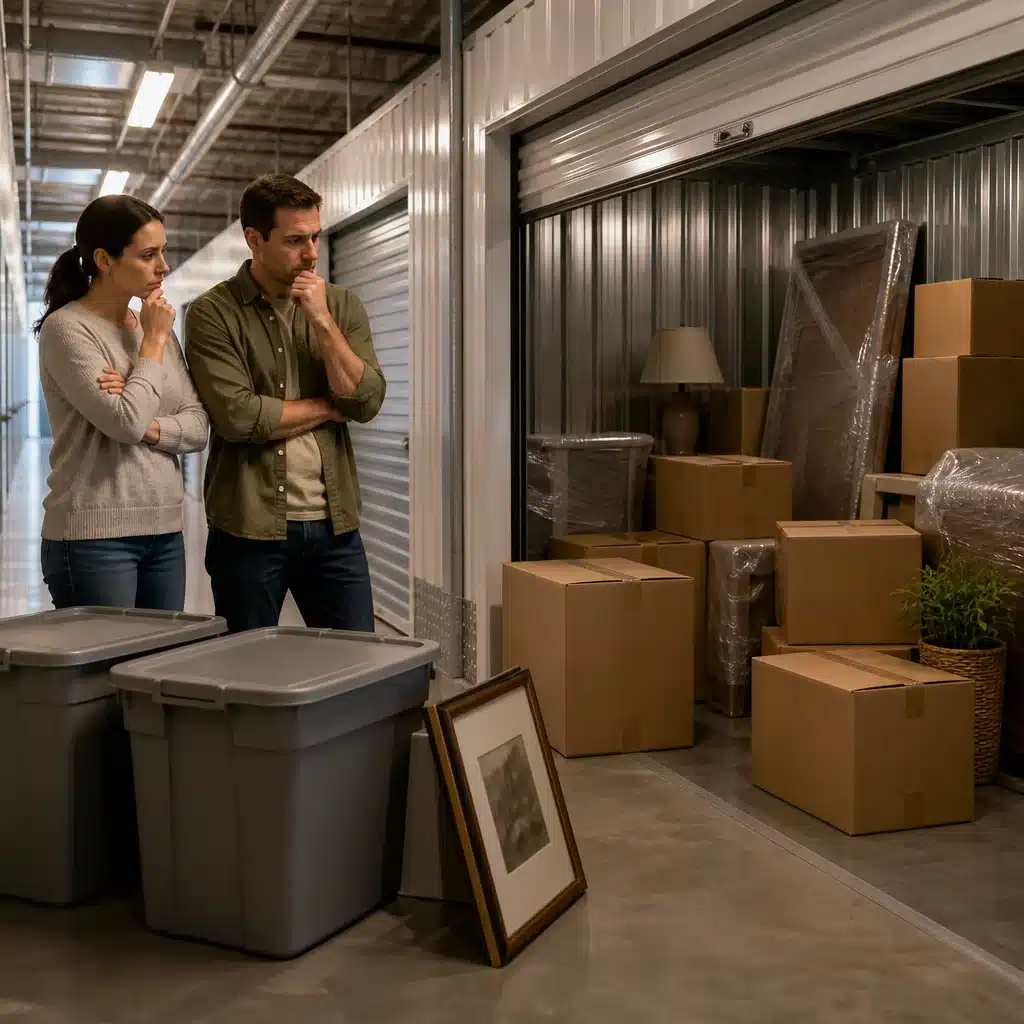
Next step: When you tour a facility, ask about the temperature and humidity ranges they maintain, how they monitor conditions, and what security measures are in place. Clear, specific answers are a good sign.
Short Term Versus Long Term Storage: Choosing the Right Option
How long your belongings will be in storage shapes the best approach. Think of it this way: short-term storage bridges a gap, while long-term storage covers an extended pause.
Short-term storage usually fits situations like:
- A few days or weeks between closing and move-in
- A brief gap while a renovation wraps up
- Temporary housing that can’t hold all of your furniture
- A transition period before a new job starts
Long-term storage is a better match when:
- You’re relocating overseas or to a location where housing isn’t yet available
- Your next home needs significant renovation before furniture can go in
- You’re downsizing and need time to decide what to keep
- You’re deploying or stationed somewhere temporarily, as many military families do
Consider a family moving from Atlanta to Denver whose new home closes six weeks after the old one. They might only need a few weeks of short-term storage for the furniture, while keeping a few boxes of seasonal items in a separate long-term unit. Splitting storage by need can save money.
Next step: Estimate how many days or months your items will need to be stored, then add a buffer of one to two weeks. Use that number to choose your storage length.
Combining Storage With Our Local and Long Distance Moving Services
One of the simplest ways to reduce stress is to keep your move and your storage with the same company. When we handle both, you have one point of contact, one schedule to track, and one team that already knows your belongings.
Here’s how the process typically works:
- We pick up your items from your current home or office.
- We transport them, whether that’s across town or across the country. Our long-distance moving services include weekly shuttles and GPS-tracked trucks.
- We store them in climate-controlled units until you’re ready.
- We deliver them to your new home when the timing works.
You can also choose to move some items directly into your new home and store the rest. This approach works well when the new home has room for the essentials but not the entire household. For Greensboro-area customers, our climate-controlled storage and moving services are designed with exactly this kind of flexibility in mind.
Next step: Ask your move coordinator to build a single timeline that includes pickup, storage, and delivery dates. Having everything in one plan prevents surprises.
Packing Service Add-Ons That Prepare Items for Storage
Storage only protects what’s packed properly. Items that go into a climate-controlled unit should be clean, dry, and secured so they can handle handling and time in storage.
Our packing add-ons help with exactly that:

- Professional packing: Our crews pack your household using appropriate materials for each item.
- Crating: Antiques, artwork, mirrors, glass tabletops, and other fragile pieces can be crated for an extra layer of protection.
- Specialized piano moving: Pianos require special handling and humidity-aware preparation before storage.
- Antique handling: Valuable pieces are moved with careful attention to fragile finishes and joinery.
You can still pack yourself, and many customers do. If you do, a few habits will help a lot:
- Clean and fully dry furniture and appliances before they go in.
- Use sealed plastic bins instead of cardboard for items that could attract moisture.
- Remove batteries from electronics and store them separately.
- Place a desiccant pack or two in drawers and closed cabinets.
- Label every box with its contents and room of origin.
Next step: Walk through your home or office and mark items that need professional crating or specialized handling. Decide early which packing services you want so we can plan the right crew and materials.
Pricing Transparency and Flat Rate Storage Estimates
Surprise fees cause more frustration than almost anything else in a move. We believe you should know what you’re paying before the truck arrives.
Our estimates are designed to be clear and easy to read. They account for:
- The volume and weight of your belongings
- The length of time items will be in storage
- Any packing, crating, or specialized handling you request
- The distance of transport, if you’re combining storage with a move
For many customers, our flat-rate moving services help make budgeting easier because the price is set before the move begins. We offer free estimates, including in-home and virtual options, so you can see the full picture on your schedule.
When you compare quotes from different companies, look at what’s included. A lower price can look attractive until you realize it doesn’t cover climate control, insurance, or packing materials.
Next step: Request a written estimate that lists each service separately. If something is unclear, ask for a line-by-line explanation before you commit.
Full Value Protection and Coverage for Stored Belongings
Accidents are rare, but protection matters when they happen. Every move with us includes basic coverage, and you can choose a higher level of protection based on what you own.
Here’s how the options break down:
- Basic coverage: Included on every move at $0.60 per pound per article, up to $50,000 in total coverage.
- Full Value Protection: Available on all moves, this option covers the replacement value of your items if they are lost or damaged while in our care.
Before choosing a level, take inventory of your most valuable items. Jewelry, artwork, antiques, electronics, and collectibles often justify full value protection, especially if they would be expensive or impossible to replace.
It’s also worth checking your homeowner’s or renter’s insurance policy. Some policies extend coverage to goods in storage, but the limits and conditions vary. A quick call to your agent can clarify what’s already covered.

Next step: Create a simple inventory with photos and approximate values for your high-value items. Keep a copy somewhere safe, and share it with your move coordinator.
Steps to Schedule Relocation Storage With American Van Lines
Scheduling storage with us is straightforward. Here’s a practical sequence to follow:
- Request a free estimate. Choose an in-home, virtual, or phone estimate, depending on what’s easiest for you.
- Share your timeline. Tell us your move-out date, move-in date, and how long you’ll need storage.
- Choose your services. Decide on packing, crating, storage length, and coverage level.
- Review and confirm your quote. Make sure everything is listed clearly before you sign.
- Prepare your belongings. Declutter, clean, and label items, and set aside anything you’ll need during the gap.
- Track your shipment. Use our app and GPS tracking to follow your belongings from pickup to delivery.
If an emergency comes up during your move or storage period, our after-hours hotline is available to help.
Next step: Call or request an estimate online, and ask for a dedicated move coordinator to guide you from start to finish.
Frequently Asked Questions About Climate Controlled Relocation Storage
Is climate-controlled storage worth the extra cost? For wood furniture, electronics, musical instruments, documents, and anything made of fabric or leather, it usually is. The added cost is small compared with repairing or replacing damaged belongings.
How long can I keep items in climate-controlled storage? Storage can be short term for a few weeks or long term for months. Tell us your expected timeline so we can recommend the right option.
Can I store part of my household and move the rest? Yes. Many customers move essentials into their new home and store the remainder. We can plan both pieces together.
What items should not go into storage? Avoid storing perishable food, flammable materials, hazardous chemicals, and live plants. If you’re unsure about an item, ask before packing it.
Do I need to be present for pickup or delivery? That depends on your situation. We can work with you on a schedule that fits, including arrangements if you’re out of town.
What’s the difference between basic coverage and full value protection? Basic coverage is included on every move and is calculated per pound per article. Full value protection covers the replacement cost of your items if they’re lost or damaged in our care, and it’s a good choice for valuable belongings.
Can I get an estimate without a home visit? Yes. We offer virtual and phone estimates in addition to in-home visits, so you can start planning from wherever you are.
Frequently Asked Questions (FAQ)
What is climate controlled storage, and why do we recommend it for relocation?
Climate controlled storage keeps indoor temperature and humidity within a set range year round, rather than letting them follow the outdoor weather. We recommend it for items that are sensitive to heat, cold, or moisture, such as wood furniture, electronics, artwork, documents, and upholstered pieces. For a move with a gap between pickup and delivery, it gives your belongings a stable environment until we can deliver them.
How long can we keep your belongings in storage during a move?
We offer both short term and long term storage, so the duration depends on your timeline. Many customers use our facilities for a few days or weeks while they close on a home or wait for a new residence to be ready. Our move coordinator can review your schedule with you and recommend the option that fits your situation.
Are our stored belongings covered if something is damaged?
Every move includes basic coverage, and we offer Full Value Protection on all moves, including items placed in storage. We will walk you through the coverage options before your move so you can choose the level that suits your belongings. Please review the terms of your agreement and let us know about any high value items so we can document them accurately.