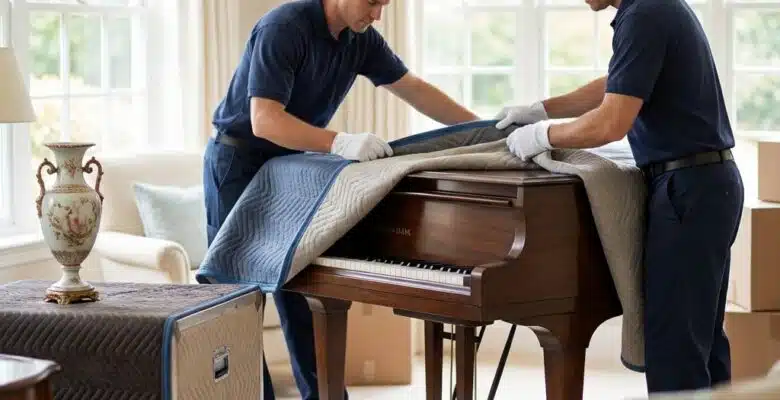
Why Specialty Moving Matters for Pianos and Antiques
Expert Piano and Antique Moving Services: White-Glove Care for Precious Valuables
Your grandmother’s upright piano. That mahogany secretary desk you inherited. The collection of oil paintings you’ve spent years acquiring. These aren’t just furniture pieces or decorative items. They’re irreplaceable parts of your history, and the thought of moving them across state lines probably keeps you awake at night.
We understand that feeling. Since 1995, we’ve specialized in moving the things that matter most to people, and we’ve learned that standard moving services simply don’t cut it when your treasures are on the line. That’s why we’ve built dedicated expertise around piano and antique relocation, and we want to walk you through exactly what makes these moves different, what can go wrong, and how we protect what you love most.
Pianos and antiques require a completely different approach than moving your couch or dining table. A piano isn’t just heavy. Its internal components are precisely calibrated instruments where wood, felt, metal strings, and hammers work in exacting harmony. A single dropped corner or aggressive tilt can damage the soundboard or throw the entire mechanism out of alignment. Similarly, antiques often feature joinery that’s centuries old, finishes that are irreplaceable, and structural integrity that depends on careful handling.
General movers are trained to move household goods efficiently. They work fast, they use standard equipment, and they follow volume-based pricing models that reward speed over precision. When you hire someone like that for a piano or a delicate secretary desk, you’re asking them to operate outside their wheelhouse. The financial and emotional loss when something goes wrong is catastrophic.
This is where specialty moving becomes essential. We bring crews trained specifically in antique and piano relocation. Our teams understand load distribution, environmental factors, and the exact techniques needed to preserve these items. We also carry insurance products and protective measures designed specifically for high-value items, which general movers typically don’t offer.
Your next step: If you own pianos, fine art, or significant antiques, mention these items when requesting an estimate. We’ll ensure the right specialists are assigned to your move.
The Risks of Standard Moving Services for Valuables
Let’s be direct: hiring a standard moving company for a piano or antique furniture is genuinely risky. Here’s why.
Most general moving companies operate on a per-pound or flat-rate model designed for bulk household goods. Their crews are trained to move quickly and protect items from weather and theft, but not from the mechanical damage that happens when delicate pieces are mishandled. A piano leg can crack if the instrument shifts during transport. Antique veneers can splinter if a piece is tilted at the wrong angle. Strings on musical instruments can snap under pressure.
Beyond physical damage, environmental factors pose real threats. Standard moving trucks don’t regulate temperature or humidity. When a 200-year-old wooden secretary desk experiences dramatic temperature swings during a cross-country move, the wood expands and contracts. Joints loosen. Veneer separates from the base. Finishes crack. Once this happens, restoration is expensive and may not fully return the piece to its original condition.
There’s also the coverage problem. Most standard movers offer basic liability coverage, often just 60 cents per pound per item. If your piano weighs 800 pounds, you’re covered for roughly $480. That same piano could easily cost $5,000 to $15,000 to repair if it’s damaged during transport. The gap between coverage and actual value is where financial disaster happens.
We’ve seen families spend three to five times what they paid for moving service just to restore items that were damaged by movers who didn’t know what they were doing. It’s preventable with the right partner from the start.
Understanding Piano Moving Requirements
A piano move is its own specialized category within relocation services. Here’s what makes it different.
First, the logistics. A standard upright piano weighs 600 to 900 pounds and requires at least three trained movers to transport safely. Grand pianos can exceed 1,200 pounds and demand more space, additional equipment, and careful angle management. Moving a piano up or down stairs involves specialized ramps, tilting mechanisms, and spotters who understand the exact center of gravity for the instrument.
The internal mechanics require equal attention. When a piano is tilted or moved, the hammers can shift. The dampers can misalign. The strings are under tremendous tension. If the piano experiences a jolt during transport, that tension can snap strings or damage the action mechanism, which is the intricate system that translates your finger pressing a key into the hammer striking the string. Repairs to piano actions run $500 to $2,000 per issue.
Temperature and humidity matter enormously. Pianos are wood and felt and metal all working together with precision. A climate-controlled environment during transport preserves the integrity of these materials. An uncontrolled truck bed can dry out the wood, causing it to shrink and create gaps, or add moisture and cause swelling.
The delivery end is equally critical. The piano needs to be positioned in your new home before being unloaded from the protective equipment. This requires us to assess doorways, hallways, and stairwells beforehand. We’ve turned down moves in the past because a piano literally cannot fit through an existing doorway without damage to both the piano and your walls. That conversation is harder after you’ve already hired someone than before.
We provide detailed guidance on piano moving requirements, including site assessments and pre-move planning. Request an in-home or virtual estimate so we can evaluate your specific situation.

Preparing Your Antiques for Transport
Antique furniture and fine art items need preparation weeks before moving day. Starting early prevents scrambled decisions made under time pressure.
Begin by documenting everything. Take clear photographs of each antique from multiple angles. Write down dimensions, materials, any repairs or restoration work it’s had, and its approximate age and origin. If you have purchase receipts, appraisals, or certificates of authenticity, gather those too. This documentation serves two purposes: it creates a record for insurance purposes, and it gives our crews critical information about how to handle each piece.
For furniture, identify any fragile elements. Antique chairs with rush or cane seating are vulnerable. Tables with inlaid veneers need protection on surfaces and edges. Mirrors and glass cabinet doors require individual wrapping. Drawers in dressers and desks should be removed and packed separately, not left in the piece, because their weight can stress old joinery.
Fine art and paintings need specific attention. Oil paintings should be crated individually, never placed flat or stacked. Frames can be damaged by pressure or bumping. Sculptures made of marble, bronze, or ceramics are brittle and require padded individual crating. If you own valuable art, we recommend getting professional appraisals before moving. This ensures your insurance coverage matches the item’s actual value.
Textiles and tapestries should be rolled, never folded, to prevent creasing historic fibers. Wrap them in acid-free tissue paper before placing them in protective tubes. Books in antique collections benefit from individual wrapping, especially leather-bound volumes where the binding can be damaged by pressure or moisture.
The key principle: give us as much information as possible about fragility and value. Our crews use this information to determine the right packing materials, crating requirements, and handling techniques for each piece.
Professional Crating and Packing Techniques
This is where specialty moving reveals its value most clearly. Standard packing and our white-glove approach to valuables are fundamentally different.
For pianos, we use custom wooden crates built to the exact dimensions of your instrument. The crate has shock-absorbing padding on all interior surfaces, corner bracing to distribute weight evenly, and ventilation holes to allow air circulation during transport. The piano is secured within the crate using tension straps, not bolts or clamps that could damage the wood finish. Once crated, the piano becomes a single protected unit that can be lifted with equipment rather than carried by hand.
For antique furniture, our professional packing services begin with assessment. We determine whether an item should be fully crated, wrapped and padded, or a combination approach. Antique tables often get custom wooden crates with internal padding for the top surface and legs. Breakfront cabinets get their glass doors removed, wrapped, and crated separately. Chairs get individual attention, with each leg and arm wrapped separately before the entire frame is shrouded in protective padding.
We use several specific techniques that distinguish our work:
- Pad wrapping: All furniture receives pad wrapping on our moves at no extra charge. This is multiple layers of moving blankets secured with tape, creating a cushioned barrier against bumps and scratches.
- Custom crating for high-value items: Items worth more than $3,000 to $5,000 typically get custom wooden crates built to precise specifications. The crate absorbs impact that would otherwise reach the item inside.
- Museum-quality wrapping for fine art: Oil paintings, sculptures, and collectible items are wrapped in acid-free tissue, then sealed in protective plastic, then placed in rigid crates with multiple inches of foam padding on all sides.
- Individual item inventory: Each packed piece is labeled, photographed during packing, and logged in our system. You’ll receive detailed documentation of what’s being transported and how it’s been protected.
The difference in outcome is measurable. Standard moving might get your antique secretary desk to your new home intact. Professional crating ensures it arrives looking exactly as it did when we picked it up.
Climate-Controlled Storage Solutions
Sometimes the move itself isn’t immediate. Perhaps you’re relocating in stages, or your new home isn’t ready for several weeks, or you need to store items temporarily during a renovation. This is where climate control becomes essential for valuable pieces.
Standard storage units offer basic protection from weather and theft. Climate-controlled storage regulates temperature and humidity within a narrow range, typically keeping temperatures between 55 and 85 degrees Fahrenheit and humidity between 30 and 50 percent. For antiques and fine art, this controlled environment is the difference between preservation and deterioration.
Our climate-controlled storage facilities are designed specifically for long-term protection of valuable items. Each unit maintains consistent conditions monitored by digital sensors. We provide regular inspections, with trained staff checking on stored items periodically to ensure nothing has shifted or deteriorated. Your items are stored off the ground on shelving or pallets, preventing moisture issues from concrete floors.
For pianos in storage, climate control is non-negotiable. A piano stored in a self-storage unit without temperature and humidity control will experience wood movement, string tension changes, and felt deterioration. When you retrieve it, the instrument may be unplayable until extensive regulation and tuning work is performed. Climate-controlled storage costs more than standard storage, but it’s dramatically less expensive than piano restoration.

If you’re storing antique furniture, fine art, or musical instruments, we recommend climate-controlled storage without reservation. The premium cost is insurance against damage that’s far more expensive to repair.
Insurance and Full Value Protection
This is a conversation we have with every customer moving valuable items, and it’s crucial.
Our basic moving coverage, included at no charge on every move, provides protection of 60 cents per pound per article, up to $50,000 total coverage. For most household goods, this is adequate. For a piano valued at $8,000, or antique furniture worth $15,000, it falls short.
Full Value Protection is a different product entirely. Under Full Value Protection, we agree that if an item is damaged during transport, we either repair it to its original condition or pay the full replacement value, not a depreciated value. This is the coverage that protects your actual financial interest.
Here’s a concrete example: Your 150-year-old Victorian settee is appraised at $6,000. During loading, it’s accidentally snagged and the frame cracks. With basic coverage, you’d receive roughly $3.60 for the item’s weight (not $6,000). With Full Value Protection, we cover the actual cost of restoration or replacement.
Before any move, we ask customers to provide appraisals or valuations for items worth more than $1,000 to $2,000. This documentation supports the insurance claim if something does happen and establishes the item’s actual value. We can help guide this process, and we provide detailed information on valuation and insurance options on our website.
For high-value moves, Full Value Protection is standard, not optional. It’s one of the few ways to ensure that an accident doesn’t become a financial disaster.
The American Van Lines Difference
We’ve been moving families and their most precious items since 1995, and our approach to specialty relocation reflects two decades of experience and continuous refinement.
First, we’re family-owned and operated. This means decisions about how we treat your piano or antique collection aren’t driven by quarterly earnings targets or corporate efficiency metrics. We care about reputation because our name is actually on the business. When a customer’s piano arrives pristine because our crew took an extra hour to do the job right, that reflects directly on us.
Second, we’ve invested in the infrastructure that specialty moving demands. We maintain specialized equipment, climate-controlled storage facilities, and ongoing training programs for crews handling valuables. We’re also ranked as a Top Mover by Forbes, Move.org, Consumer Affairs, and Newsweek, and we’re recognized by USA Today and Newsweek as award-winning. These rankings don’t come from moving average household goods well. They come from excellence in complex, high-stakes relocations.
Third, we’re transparent about what we’re doing and why. We provide free estimates, both virtual and in-home, so you understand exactly what your move will cost and how we plan to protect your items. No surprises. No hidden fees. Just clear, honest communication from the start.
Finally, we assign a dedicated move coordinator to every relocation. This person becomes your single point of contact, understanding the specifics of your move, your concerns, and your timeline. They’re here to answer questions during business hours and can be reached through our after-hours hotline if an emergency arises during transport.
Specialized Equipment and Air-Ride Trucks
The equipment we use for specialty moves is fundamentally different from standard moving trucks.
Our air-ride trucks feature sophisticated suspension systems that absorb road vibration and impact. Instead of a traditional leaf spring suspension that transmits every bump to the cargo, air-ride suspension uses compressed air to create a cushion between the truck frame and the cargo compartment. For a piano traveling 500 miles, the difference in vibration exposure is substantial. Less vibration means less mechanical stress on internal components.
Inside the truck, we use custom bracing systems. We don’t simply load a crated piano and strap it down. Instead, we use adjustable wooden braces that contact the crate on multiple points, distributing the cargo weight throughout the truck bed rather than concentrating it in one area. During acceleration, braking, and turns, this distributes forces evenly rather than allowing shifting or tipping.
For fine art and delicate antiques, we use individual compartments within the truck. Rather than loading your items loose with household goods, each valuable piece travels in its own dedicated space with shock-absorbing padding on all sides. This prevents items from bumping against each other or shifting during transport.
We also equip moving trucks with GPS tracking, so you can monitor your shipment in real time. You’re not wondering whether your piano is sitting in a parking lot somewhere. You can see exactly where it is and when it will arrive.
Trained Specialists in Valuables Relocation

Not every mover at American Van Lines handles piano and antique moves. We select and train specific crews for these specialized relocations.
Our piano moving specialists understand the mechanical and structural realities of pianos. They know how to position lift equipment to avoid stressing the case. They understand load distribution when a piano is tilted. They know the exact angle at which a piano can be moved without internal components shifting. This knowledge comes from training, but also from experience moving hundreds of pianos.
Our antique furniture specialists are trained in recognizing fragile construction. They can identify hand-joined drawers that require special care, inlaid veneers that are vulnerable to pressure, and structural points where the piece is strongest and weakest. They approach each piece as if it’s irreplaceable, because often it is.
When you contact us about a piano or antique move, we pair you with a coordinator who has handled similar items. You’re not training a new mover to understand your needs. You’re working with someone who has done this work before and knows what to expect.
Our crews also maintain professional demeanor and courtesy throughout the process. Moving is stressful, especially when valuables are involved. You’re trusting someone with items that have emotional and financial significance. Our trained movers understand this and treat your home and your items with the respect they deserve.
Getting Started with Your White-Glove Move
If you’re planning to relocate with pianos, antiques, fine art, or other valuable items, here’s how we move forward together.
Step one is a detailed conversation about your items. When you request an estimate, provide as much information as possible about what you’re moving: dimensions, approximate weight, age, materials, current condition, any restoration history, and estimated value. Photos are incredibly helpful. The more we know upfront, the more accurate our assessment and recommendation will be.
Step two is the estimate itself. We offer both virtual estimates (where you show us items via video or detailed photos) and in-home estimates (where our coordinator visits your location). In-home estimates are typically better for complex moves involving multiple valuable pieces or when doorway and stairwell access needs to be evaluated. These estimates are free and come with specific recommendations for crating, packing, storage, and insurance.
Step three is planning. Once you’ve accepted an estimate, your dedicated move coordinator develops a detailed plan specific to your move. This includes pickup and delivery dates, crew assignments, equipment reservations, and any special preparations needed from you. For piano moves, we’ll typically schedule an in-home assessment a few days before pickup to ensure we have the right equipment and crew size.
Step four is execution. On moving day, our crew arrives ready to work with precision and care. Pickup typically takes longer for specialty moves than standard relocations because the work is more deliberate. That’s intentional. We’re protecting your investment.
Final step is delivery and setup. When items arrive at your new location, we’ll position them where you want them and remove protective coverings. We don’t just drop off a piano on your floor and leave. We place it, check that it’s level, and ensure it’s positioned in the space you’ve designated.
Throughout the entire process, you have direct contact with your move coordinator and access to our after-hours hotline if questions arise.
We know moving treasured items involves trust and confidence in the people handling them. That’s not something we take lightly. Our 30-year track record, professional recognition, and commitment to transparency are built on thousands of moves where we protected what mattered most to families and businesses across the country.
When you’re ready to move your piano or antique collection, we’re here to make sure it arrives safely and looking exactly as it should.
Frequently Asked Questions (FAQ)
How much does it cost to move a piano?
Piano moving costs depend on distance, piano type, and local access conditions. Local moves typically range $1,500-$3,000, while long-distance moves cost $3,000-$5,000 or more. American Van Lines provides free estimates that account for your specific piano specifications and route to give you an accurate price.
What protection do pianos and antiques have during transport?
All American Van Lines moves include free basic coverage at $.60 per pound per article, up to $50,000 total. For high-value items, Full Value Protection is available on all moves and covers the replacement cost of items if damage occurs. Your personalized move coordinator will discuss coverage options based on your items’ assessed value.
Why is climate-controlled storage important for antiques?
Antiques are sensitive to temperature and humidity fluctuations, which cause wood to warp, veneers to crack, and finishes to deteriorate. American Van Lines offers climate-controlled storage that maintains consistent temperature and humidity levels, protecting your items during any delay between pickup and delivery.